

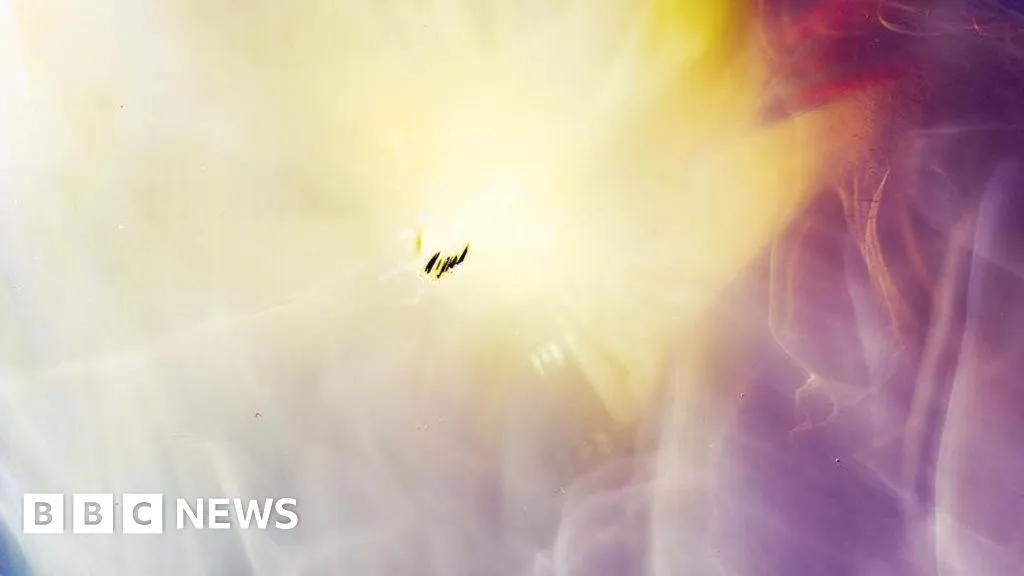
A photography student at Arts University Bournemouth has developed a groundbreaking technique to create unique artwork using cosmic rays from the edge of space.
The Innovative Process
Tom Liggett, pursuing a BA (Hons) in Photography, seals blank negative film in a plastic bag and launches it toward space via a helium balloon. At altitudes far beyond commercial aircraft—reaching up to 121,000 feet—cosmic radiation exposes the film, producing striking patterns instead of traditional light exposure. This method marks a pioneering achievement in photography.
The balloon ascends until it bursts, parachuting the film back to Earth for Liggett to develop. He attaches a tracking device to the package for recovery.
From Curiosity to Experiment
The idea originated from a bold question: what happens to undeveloped film exposed to space radiation? Liggett notes, “It came at the beginning from the question of what would happen if I sent a negative of film into space. It was a really wild question. The chances of this not working were very high, because as far as I know, no one’s ever achieved it before.”
Photographers often worry about radiation fogging film, such as from airport X-ray scanners. Liggett first tested dental and hospital X-rays before partnering with a US-based company specializing in high-altitude helium balloon launches. He traveled to New York State for the latest mission.
“A lot of people think when I say these things that there’s a camera involved taking the image,” Liggett explains. “There is nothing. It’s literally just a plastic bag and a sheet of film inside it, duct-taped down—that’s it.”
Unexpected Results and Insights
Liggett approached the first launch with low expectations. Upon developing the returned film at Arts University Bournemouth, he discovered intricate patterns. “There was something on the negative, this kind of like pattern. I knew at that point that I’d achieved something literally unimaginable,” he recalls.
Research into the launches reveals the patterns stem from UVC radiation above the ozone layer, cosmic rays, and muons originating from distant black holes billions of light-years away. Liggett asserts, “I actually think it’s a more accurate representation of space than a photograph is. It’s capturing the actual molecular formula of space.”









