

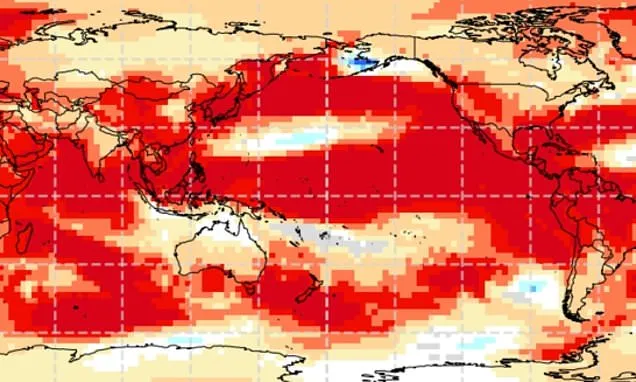
Scientists warn that a powerful super El Niño event could emerge as early as May or June, driving global temperatures to unprecedented levels. This natural climate phenomenon, part of the El Niño-Southern Oscillation (ENSO) cycle, features sustained warming in the Pacific Ocean exceeding 2°C (3.6°F), often labeled a super El Niño.
Understanding the El Niño Cycle
The ENSO cycle alternates between warm El Niño phases and cool La Niña phases every two to seven years. During El Niño, warm Pacific waters spread eastward, releasing heat into the atmosphere and elevating Earth’s average surface temperature for months. Current observations reveal sea surface temperatures in the tropical Pacific rising faster than at any point this century, signaling a potent event ahead.
Strong Predictions from Leading Agencies
The World Meteorological Organization (WMO) indicates high confidence in El Niño’s onset, with potential intensification soon after. Wilfran Moufouma Okia, Chief of Climate Prediction at WMO, states: “Climate models are now strongly aligned, and there is high confidence in the onset of El Niño, followed by further intensification in the months that follow. Models indicate that this may be a strong event.”
A Met Office spokesperson confirms: “Current forecasts indicate a strong shift in the tropical Pacific later this year, with conditions increasingly supportive of the development of El Niño.” Their models project sea surface temperatures up to 1.5°C (2.7°F) above average, potentially the strongest event this century.
The National Oceanic and Atmospheric Administration (NOAA) estimates a one-in-four chance of a very strong El Niño with anomalies over 2°C. Atmospheric scientist Professor Paul Roundy at the State University of New York at Albany highlights the “real potential for the strongest El Niño event in 140 years.”
Amplified Warming and Record Risks
Though ENSO operates independently of climate change, a strong El Niño can superimpose extra heat atop greenhouse-driven warming, spiking temperatures dramatically. For instance, 2024 marked the hottest year on record due to this synergy. With 2025 tying 2023 as the second-warmest, a super El Niño raises the odds of 2026 and 2027 shattering records.
Dr. Marc Alessi, a fellow at the Union of Concerned Scientists, notes: “While the majority of models predict global monthly temperature anomalies will remain below 2C, the fact that there’s a nonzero chance of +2C happening is shocking.” WMO forecasts above-average land temperatures nearly worldwide in May and June, hitting North America, Europe, North Africa, Central America, and the Caribbean hardest.
Global Weather Disruptions
El Niño reshapes weather patterns unevenly: intense heat grips Europe and South America, while southern North America faces cold snaps and floods. Expect heightened rainfall and flooding in South America, the United States, the Horn of Africa, and Central Asia. Conversely, Australia and Indonesia risk severe droughts, with elevated wildfire threats across Southeast Asia.









