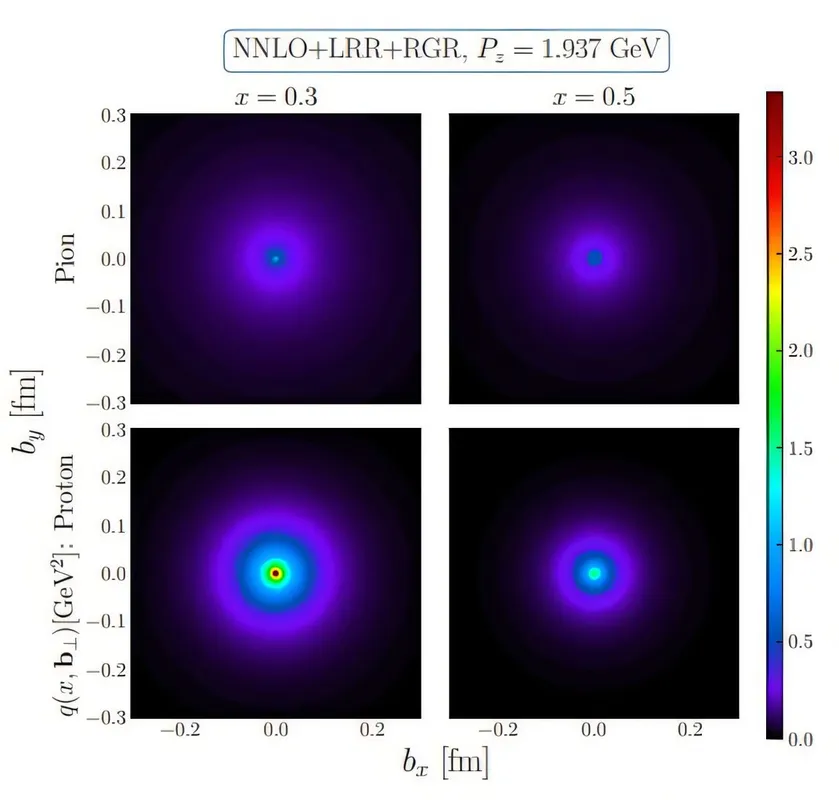
Researchers have utilized a powerful supercomputer to achieve an unprecedentedly detailed view of a pion’s internal structure. Pions, fundamental subatomic particles, play a critical role in binding matter at the smallest scales and are intrinsically linked to the strong nuclear force. This force is responsible for holding protons and neutrons together within atomic nuclei.
Unveiling the Pion’s Secrets
Understanding the mechanics of pions offers crucial insights into the formation of matter at its most basic level. Yong Zhao, a icist and lead investigator on the project, explained that pions act as mediators of the strong force that binds nucleons, which are the protons and neutrons contributing to an atom’s mass. For decades, scientists have sought to comprehend the distribution of quarks within composite particles governed by the strong nuclear force. Due to a scarcity of experimental data for the lightest of these particles, the pion, researchers have turned to sophisticated simulations to discern its three-dimensional internal arrangement.
This work addresses a core puzzle in nuclear ics: how visible matter emerges from elementary particles like quarks and gluons. Zhao stated that by quantifying the pion’s multidimensional structure, a profound understanding of its composition can be achieved. Probing the pion’s interior provides deeper knowledge of how quarks and gluons are confined to create the matter we observe.
Advanced Simulation Powers Discovery
To investigate the pion’s structure, the research team, including scientists from Brookhaven National Laboratory, employed the Polaris supercomputer. This powerful tool, combined with advanced theoretical models, allowed for simulations of the strong force’s ics. The simulations generated high-resolution three-dimensional images, illustrating the arrangement of quarks within the particle.
Zhao detailed how Polaris enabled the simulation of quark movement and correlation within the pion, both longitudinally and transversely. He noted that the simulation captured hundreds of snapshots across four-dimensional spacetime, rendered on a grid with millions of points. This computational feat, achievable only with massive parallel processing capabilities like those of advanced supercomputers, yielded detailed images of the quark structure within a moving pion. These visuals showcase the transverse spatial distribution of quarks carrying varying fractions of the pion’s momentum.
Key Findings and Future Implications
The computational results revealed the pion’s quark generalized parton distribution (GPD), facilitating the creation of a detailed three-dimensional image. The pion GPD was determined with controlled uncertainties across different quark longitudinal momentum values, measured both along and perpendicular to the pion’s direction of motion.
Zhao reported that the findings indicate a decrease in the pion’s transverse size as its forward momentum increases, a pattern also observed in protons. Furthermore, at moderate parallel momentum values, the effective size of the pion is smaller than that of the proton. Given the current absence of experimental measurements for the pion GPD, these theoretical results offer vital guidance and support for upcoming experimental endeavors, including those at the Thomas Jefferson National Accelerator Facility and the planned Electron-Ion Collider at Brookhaven.
The next phase of research will involve using an even more powerful supercomputer, Aurora, to map the proton in three dimensions. Protons, along with neutrons, form the atomic nuclei that constitute all the visible matter in the universe.