Groundbreaking Discovery in Quantum Materials Control
Quantum materials, governed by the intricate laws of quantum mechanics, are at the forefront of developing advanced technologies. A critical aspect of their functionality lies in their ability to undergo phase transitions, altering how electrons navigate through them. While transitioning from insulating to metallic states via light has been demonstrated, achieving the reverse – a metal-to-insulator transition using light alone – has remained a significant challenge.
Researchers Achieve Ultrafast Metal-to-Insulator Transition
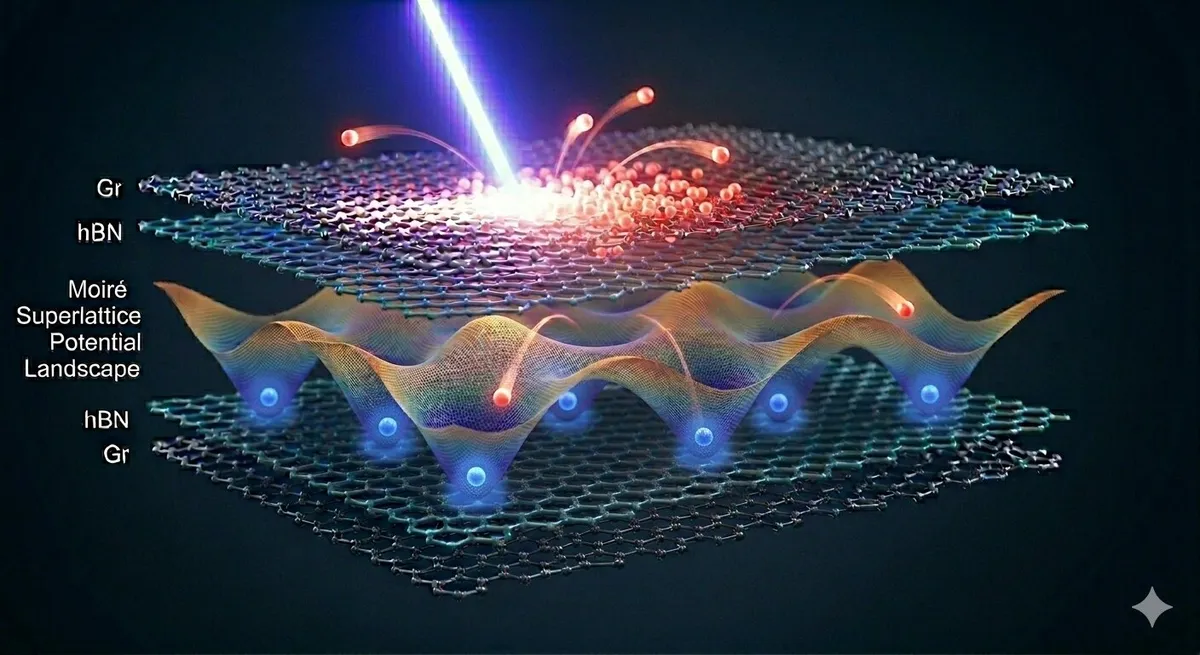
A collaborative effort by researchers at Columbia University and UC Riverside has successfully demonstrated an ultrafast, photo-induced metal-to-insulator transition in two-dimensional (2D) moiré heterostructures. These novel quantum materials, composed of stacked 2D layers with precise misalignment, hold immense potential for revolutionizing quantum technologies and high-speed optical devices.
A Serendipitous Observation Drives Innovation
The team was initially investigating pump-probe spectroscopy to gain a time-domain understanding of moiré quantum matter. During their analysis, a surprising observation emerged regarding the role of graphite electrodes, typically used for electrostatic gating. It was noted that these electrodes absorbed a significant portion of the excitation energy, leading to an unexpected functional outcome.
Fabrication and Experimental Setup
To conduct their research, the scientists engineered moiré devices by layering ultra-thin tungsten disulfide (WS2) and tungsten diselenide (WSe2). Electrical charge was introduced into these devices using graphite gates. The material was then subjected to brief laser pulses, initiating the photoexcitation process.
The Transition Unveiled
Initially, the devices were configured into a metallic state, allowing for unimpeded electron flow. However, shortly after excitation by the laser pulses, a dramatic shift occurred, with the devices transitioning into correlated insulating states. This phenomenon represents a reversal of the more commonly observed insulator-to-metal transition.
As explained by a lead researcher involved in the study, “In the photoexcitation of charge-doped moiré quantum matter, pump excitation results in the disruption of a correlation, as is observed for the photo-induced insulator to metal transition (IMT), with characteristic spectroscopic signatures. The present paper results from a serendipitous discovery. At high pump powers, we made the astonishing observation of a spectroscopic signature for the reverse process, i.e., a metal-to-insulator transition.”
Unraveling the Mechanism
Extensive analysis was conducted to elucidate the ical mechanisms behind this photo-induced phase transition. The findings point to the ultrafast injection of photoexcited holes from the graphite electrode as the primary driver of this remarkable transformation.
Implications for Future Technologies
This breakthrough offers a promising pathway for developing next-generation quantum devices capable of ultrafast transitions. Potential applications include the creation of advanced quantum memories and sophisticated quantum processors.
“Our findings provide an effective means to control carrier density in moiré quantum phases on ultrafast time scales,” stated a researcher. “This paper should also be considered a methodology foundation for future studies of van der Waals structures with ultrafast laser pulses.”
Paving the Way for Further Exploration
The research team is eager to leverage this discovery to precisely control various moiré quantum phases on ultrafast timescales and to uncover potentially hidden quantum states. Future work will focus on exploring the full potential of this approach for optimizing quantum device performance.
Publication details: Yiliu Li et al, “Photoinduced Metal-to-Insulator Transitions in 2D Moiré Devices,” ical Review Letters (Year). DOI: [DOI Number]. Available on arXiv: [arXiv DOI]