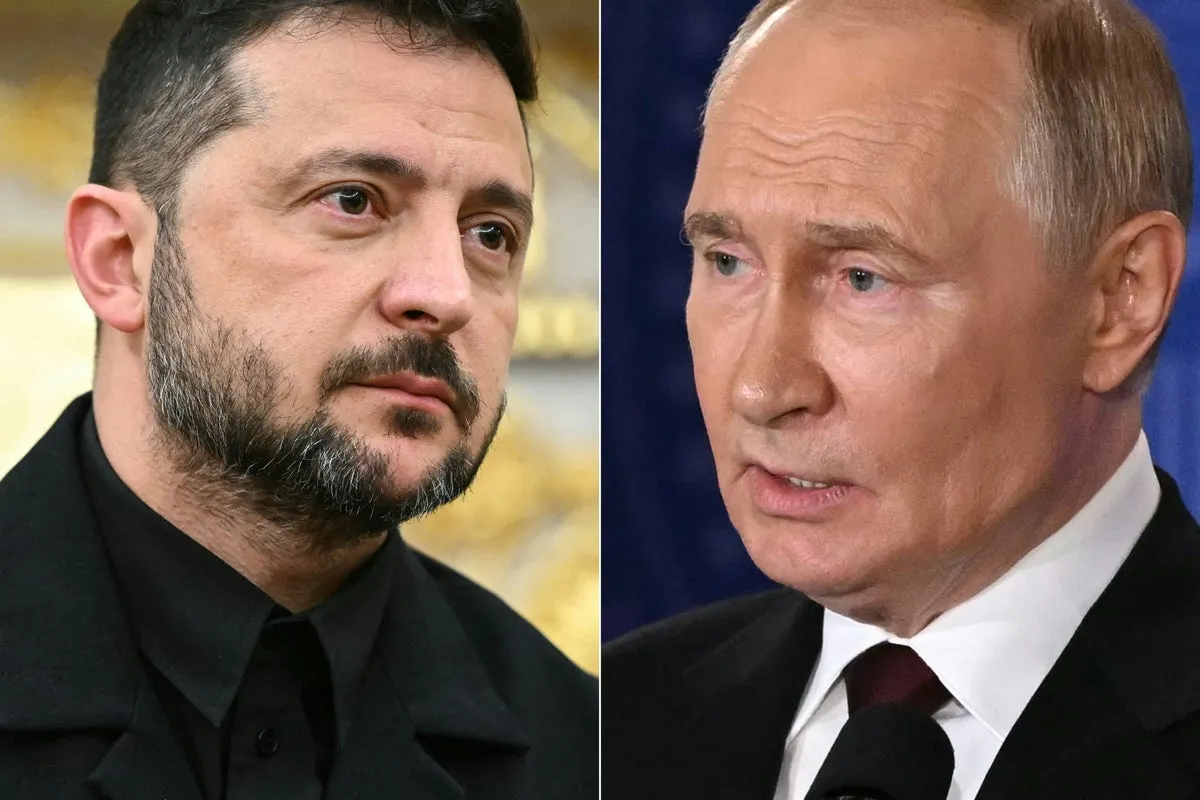
Ukrainian President Volodymyr Zelensky has characterized Russian President Vladimir Putin’s response to his peace summit proposal as “weak” and indicative of Moscow’s unwillingness to end the ongoing conflict. Zelensky’s remarks followed Putin’s statement on Friday that he saw no immediate reason to meet with the Ukrainian leader, dismissing an open letter proposing face-to-face talks as insincere and containing “rude remarks.”
Zelensky’s Peace Overture Dismissed
In his open letter, circulated to various nations including the United States, President Zelensky suggested that a majority of Russians are weary of missile and drone attacks, inflation, and fuel shortages, and are ready for peace. He also alluded to the potential for the war to threaten Putin’s own position, noting that historical precedent shows change often follows when Russia grows tired.
Speaking at an economic forum in St. Petersburg, President Putin countered that Zelensky’s letter did not appear to be a genuine offer for dialogue. “This letter contains some rather rude remarks. Was it a way to create the conditions for a face-to-face meeting or a way not to set up a face-to-face meeting? I think it was the latter,” Putin stated. When asked about a potential meeting, he was direct: “I don’t see the point in meeting; the only point is for the Ukrainian side to halt the advance of our armed forces. But we need agreements – not for six months, not for three months, but for the long term.” Putin also commented on Zelensky’s mention of his age, stating, “the main thing is not an age, but ability to work.” He further questioned Ukraine’s reluctance to involve the Trump administration as a guarantor of peace talks, expressing gratitude to Donald Trump for his potential involvement.
Zelensky: Russia Chooses War
In his nightly video address, President Zelensky asserted that Putin’s rejection of his meeting proposal clearly demonstrates the Kremlin’s lack of desire to cease hostilities. “Unfortunately, the Russian side is once again choosing war – everyone hear the response. A weak response,” Zelensky said, adding, “I think this response will have disappointed many in the world.” He accused Putin of wanting to maintain the status quo and benefiting from the war, stating, “He does not want to change anything, and he does not want to admit that this war appeals only to him – and to those who are making money off him. They were all smiling very broadly today.” Zelensky concluded that this situation necessitates increased financial pressure on Russia.
Armenia’s Geopolitical Crossroads
Meanwhile, Armenia is preparing for parliamentary elections that could significantly alter its geopolitical alignment. Prime Minister Nikol Pashinyan is advocating for closer ties with the European Union and the United States, despite enduring historical connections with Russia that are supported by his critics. While many analysts predict Pashinyan’s Civil Contract party will retain parliamentary control, the presence of numerous pro-Russia opposition parties has brought the nation’s international standing into sharp focus.
In the lead-up to the vote, Russian officials have cautioned Armenia that closer integration with the EU could jeopardize its economic ties with Moscow and its allies. “These are the first elections in Armenia’s history where geopolitical orientation has become a decisive issue,” noted Mikayel Zolyan, an analyst and former Armenian parliament member. He explained that while Armenia has largely remained within Russia’s sphere of influence, this is now being openly questioned.
Relations between Moscow and Yerevan deteriorated in 2023 after Azerbaijan gained control of the entire Karabakh region, which had been held by ethnic Armenian forces backed by Armenia. Armenian authorities accused Russian peacekeepers of failing to prevent Azerbaijan’s offensive, a claim Moscow, preoccupied with the conflict in Ukraine, denied, citing a lack of mandate for intervention.
Alexander Iskandaryan, director of the Caucasus Institute in Yerevan, observed, “It turned out that Russia’s image as a guarantor of Armenian security was not based in reality, and it all collapsed after the Karabakh war.” In response, Prime Minister Pashinyan has taken steps to cautiously distance Armenia from Moscow, including joining the International Criminal Court in 2023 and suspending participation in the Moscow-led Collective Security Treaty Organisation in 2024.
Montenegro Nears EU Membership
In other European developments, Montenegro is reportedly on track to join the European Union by 2028, according to bloc leaders and the country’s president, following a summit focused on EU enlargement. Ukraine and Moldova are also among the approximately ten countries aspiring to join, with Iceland set to hold a referendum on an application in August.
Leaders from the EU and the Western Balkans convened in Tivat, Montenegro, to discuss the bloc’s expansion into a region considered crucial for countering security and economic challenges posed by Russia and China. European Commission President Ursula von der Leyen stated that Montenegro’s accession is “within reach.” “If I had to sum up this summit in two words, they would be determination and confidence,” von der Leyen remarked at a news conference. “Confidence that our union will grow in the years ahead.” A working group has been established to draft an accession treaty for Montenegro, with President Jakov Milatovic expressing increased confidence in meeting the 2028 target.
Romania Deploys Helicopters After Drone Incident
Romania has deployed helicopters to search for additional drones and issued text message alerts to residents following the explosion of a Ukrainian maritime drone at a Black Sea port. Raed Arafat, head of Romania’s Department for Emergency Situations, confirmed these preventive measures, stating, “There is a possibility that there may be other drones.” Over 1,300 people were evacuated from Black Sea beaches and access routes were temporarily closed after the incident, though evacuation measures were later suspended.
The drone, reportedly used in Ukraine’s conflict with Russia, detonated at the port of Constanta around 10:30 am on Friday, after being secured and isolated by Romanian authorities. Three other sea drones reportedly exploded offshore. The Romanian government stated that Ukrainian counterparts confirmed they had lost control of four drones. Romanian President Nicusor Dan suggested that Russia’s electronic warfare might have caused Ukraine to lose control of the drones, leading to their incursion into Romanian airspace.
The Ukrainian Navy confirmed it had lost control of an unmanned naval boat during operations in the Black Sea and was in contact with Romanian authorities to prevent civilian casualties.
Zaporizhzhia Nuclear Plant Safety Concerns
Concerns persist over the safety of the Zaporizhzhia nuclear plant, Europe’s largest, which has been occupied by Russian forces since the early stages of the invasion. Both sides have accused each other of actions compromising nuclear safety.
On Thursday, the plant’s Russian-installed management accused Ukraine of deploying over 20 drones to attack a nearby thermal plant crucial for the facility’s external power supply. The nuclear plant requires external power to prevent its nuclear fuel from overheating. The International Atomic Energy Agency (IAEA) reported that the plant’s second external power line was down following attacks on electrical substations across the Dnipro River. The facility is currently relying on diesel generators.
Separately, Russia’s nuclear energy corporation Rosatom reported that a Ukrainian drone struck engineers demining an area around the plant, injuring at least three people, two of whom are in serious condition. Rosatom head Alexei Likachev described the strike as deliberate and called for international awareness of ongoing attempts to damage the plant and its personnel, despite agreements. The IAEA confirmed it had been informed of the incident and its director general urged maximum military restraint and adherence to the ceasefire.
Putin Meets Former German Chancellor
In a separate development, Kremlin aide Yuri Ushakov reported that Russian President Vladimir Putin held a “good and friendly” one-on-one meeting with former German Chancellor Gerhard Schroeder in Moscow. Ushakov noted that such informal contacts are common and that details of the discussion were not publicly disclosed.
Schroeder, who served as German Chancellor from 1998 to 2005, has since worked for Russian state companies and maintained a close relationship with Putin. Earlier, Putin had suggested Schroeder as a preferred partner for negotiating new European security arrangements. However, EU foreign ministers have rejected any role for Schroeder in such discussions.