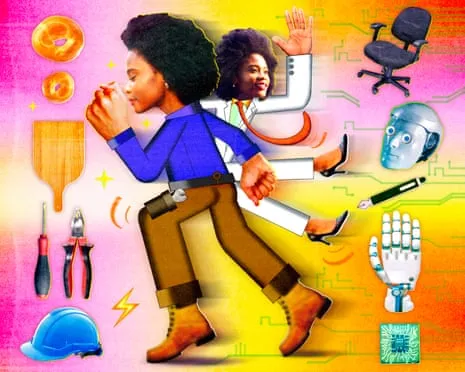
White-Collar Workers Pivot to AI-Resistant Careers
Artificial intelligence disrupts traditional white-collar roles, prompting professionals to retrain in trades and manual jobs. Writers, editors, and safety experts seek stability in fields like therapy, baking, and electrical work, where human skills remain essential.
From Freelance Writing to Therapy
Jacqueline Bowman, a 30-year-old California resident, pursued writing since age 14, starting with a newspaper internship and studying journalism. After freelancing in content marketing and journalism from age 26, her work dwindled in 2024 due to layoffs and AI adoption. Clients offered editing gigs for AI-generated content at half her rate, yet it doubled her time spent fact-checking fabricated material.
“I now had to meticulously fact-check every single thing in the articles. And at least 60% of it would be completely made up,” Bowman says. She rewrote most pieces, earning less for more effort. Some clients accused her of using AI, despite her insistence otherwise. By January 2025, unable to afford health insurance, she advanced her wedding to access her husband’s plan and enrolled in university to become a marriage and family therapist.
“It’s not AI-proof,” Bowman admits, noting AI therapy options exist. However, she believes demand persists for human therapists among those wary of technology.
Academic Editor Turns Baker
Janet Feenstra, 52, from Malmö, Sweden, shifted from freelance academic editing to baking amid AI threats. Since 2013, she polished researchers’ English for international journals alongside part-time university work. Fears of AI handling such tasks led her to culinary school for financial security as a divorced mother of two.
The transition proved tough: she moved out due to rent issues, relying on her partner during training. Now at a local bakery for five months, she enjoys hands-on dough work and camaraderie. “We listen to music and we dance and sing whenever we want,” she says, though pay is lower and the job more physically demanding. She recently secured a new flat for her sons, viewing it as a milestone despite bitterness over the forced change.
Surge in Vocational Training
Angela Joyce, CEO of Capital City College in London, observes rising enrollment in trades like engineering, culinary arts, and childcare across all ages. This shift from academic paths links to youth unemployment among graduates and AI’s rise, as people target irreplaceable roles.
Richard, 39, from Northampton, left 15 years in occupational health and safety for electrical engineering. AI automated policies and procedures, threatening mid-level jobs. Concerned about safety over cost-cutting—sparked by a friend’s workplace death—he preempted changes. Trades offer resilience through dexterity and problem-solving, though automation looms, like BMW’s robot tests.
Expert Insights on AI’s Labor Impact
Carl Benedikt Frey, associate professor at the Oxford Internet Institute, notes manual work resists automation but AI affects broad industries. Home repairs increasingly rely on AI guidance, reducing calls for engineers. Current labor data shows minimal disruption, mainly entry-level, possibly tied to economic factors. He revises earlier predictions, as autonomous vehicles lag.
“As AI gets better, its capabilities improve, I think it’s likely that we will see it on a bigger slice of the labour market. But we’re not seeing it yet,” Frey says. He advises early-career professionals, like translators, to retrain proactively.
A October 2025 King’s College London study highlights declines in software engineering and management consulting. Dr. Bouke Klein Teeselink, the author, cautions against mass unemployment fears from history but notes AI may erode human advantages. Mastering AI collaboration proves valuable.
Adapting and Innovating
Birmingham entrepreneurs Fayyaz Garda, 25, in procurement, and Arun Singh Aujla, 25, in social media marketing, launch AI consulting via self-taught YouTube skills. They plan AI agents for calls and emails, preserving human management. “AI won’t replace me, but it may take a large market share out of my business,” Singh Aujla says.
Paola Adeitan, 31, abandoned solicitor training post-law degrees, citing AI-filled entry-level law jobs. She volunteers legally but works in health, open to further shifts. Faz, 23, ditched geography at Manchester University for electrical installation, deeming trades future-proof.
Bethan, 24, from Bristol, lost her university IT helpdesk role to an AI kiosk despite defenses for human needs. Hypermobility limits her cafe job; entry-level offices vanish to AI, trapping career progression.
Challenges and Human Edge
Trades demand physical toll, harder for older workers like Richard and Feenstra, who eyes bakery ownership. Uncertainty clouds advice: “How am I supposed to advise them when I don’t even really know if what I’m doing is the right path?” Feenstra asks.
Experts affirm human preferences in ballet, theater, sports, therapy, and childcare. Social skills and expertise to guide AI endure. Frey urges measured concern: impacts may unfold in years, not immediately.