

Melbourne’s Royal Exhibition Building, the nation’s largest and most grand structure in 1901, hosted Australia’s inaugural federal parliament opening on May 9, 1901. This weekend, the fully restored World Heritage-listed site celebrates the 125th anniversary of that pivotal nation-building event, featuring original interior decor revived in the 1990s after layers of mismatched paint.
Revived Treasures and Reflections on Democracy
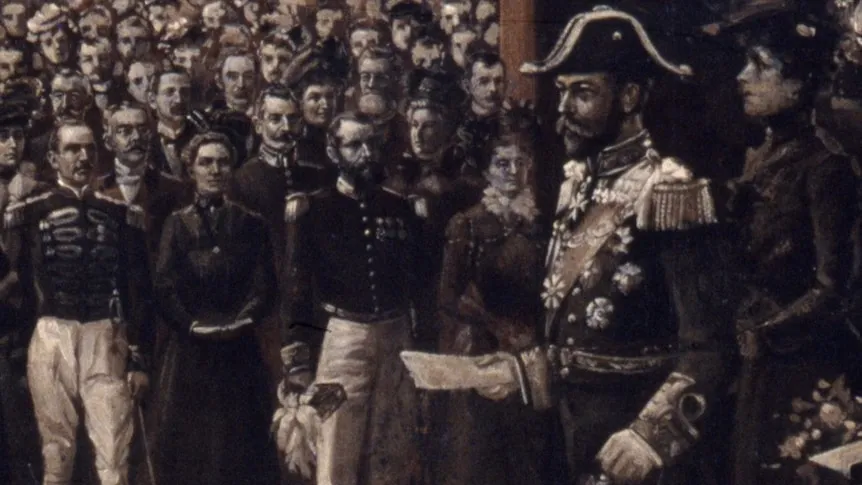
Museums Victoria showcases rare artifacts, including Charles Nuttall’s monumental painting of the parliament opening, unseen publicly since 2001. Michelle Stevenson, head of history and technology at Museums Victoria, highlights the event’s enduring impact.
“One of the things that was exciting about 1901 was that hope and vision that Australians had for the new Australian nation,” Dr. Stevenson states. “Obviously that went on to be quite complex as it ushered in moments like the beginning of the White Australia Policy and the constitutional exclusion of First Nations people. As a counterpoint, we’ll be displaying one of the copies of Victorian Treaty documents and just asking people to reflect on what they want the next 125 years of democracy in Australia to look like.”
A Royal Visit and Massive Crowds
George, Duke of Cornwall and York, and his wife Mary, heirs to the throne, made their first visit to Australia for the occasion. At 35, George would ascend as king nine years later. Their tour thanked British colonies for Boer War support, drawing half a million spectators to Melbourne’s streets.
Inside the building, packed with 12,000 attendees, The Argus described the scene as “a magnificent demonstration” and “a masterpiece of organisation.” “By the hand of Royalty, in the presence of the greatest concourse of people that Australia has seen in one building, and with splendid pomp and ceremony, the legislative machinery of the Commonwealth was yesterday set in motion. The day was full of smiles and tears, the smiles predominating,” the newspaper reported. “The worthiest of Australia were there—the men who hold their distinguished positions because they have won them and because they deserve them. All that is best in politics, in commerce, in industry, in the arts, in the church, in the school, in the public service of Australia was represented there, and every heart beat high with pride and with hope.”
Charles Nuttall’s Epic Painting
Artist Charles Nuttall, aged 29, captured the grandeur in a four-meter-wide, two-meter-high canvas commissioned by Melbourne businesses. Featuring over 340 identifiable faces, the sepia-toned work required on-site sketches and 18 months of portrait sittings. Prime Minister Edmund Barton proved restless, while Opposition Leader George Reid often dozed, testing the artist’s patience.
Contemporary Photographic Recreation
Photographer Tiffany Garvie recreates Nuttall’s masterpiece in full color for the anniversary. “We’ll definitely be going with a much more contemporary look for the photo. We’re going to be having some pretty big names in the room so ideally we’d like to be able to show their faces and keep the image as clear as possible,” Garvie explains. “We’ll be going for a much more natural look and a more realistic look and I think being able to document who’s there on the day is pretty important.”
As a Gunggari woman, Garvie notes the significance: “Aboriginal people are the most documented people on earth and having the opportunity now to flip that around to document parliament as a First Nations photographer is definitely a different take on that. I’m very proud to be able to capture this moment because we’re not only capturing politicians in this photo, but we’re also documenting the Aboriginal community who are involved in this event as well, putting ourselves in history as equals and being included in this moment.”
Restoring a Forgotten Witness
Sabina Peipers, seated front row beside her father, German Consul Wilhelm Alexander Brahe, watched the Duke’s speech. Brahe appears in Nuttall’s painting among 344 dignitaries, but Nuttall inserted himself in Sabina’s spot. Museums Victoria displays her original invitation and conserved black silk satin dress.
“While there was definitely that sense of exclusion, particularly in Nuttall choosing to do that, we do then see that inclusion of women in Australia’s political system with the opening of federal parliament, from that moment onwards,” Dr. Stevenson observes. “We’ll be having those objects out for display, so we’re putting Sabina back into the story and back into her rightful place in that significant moment.”









