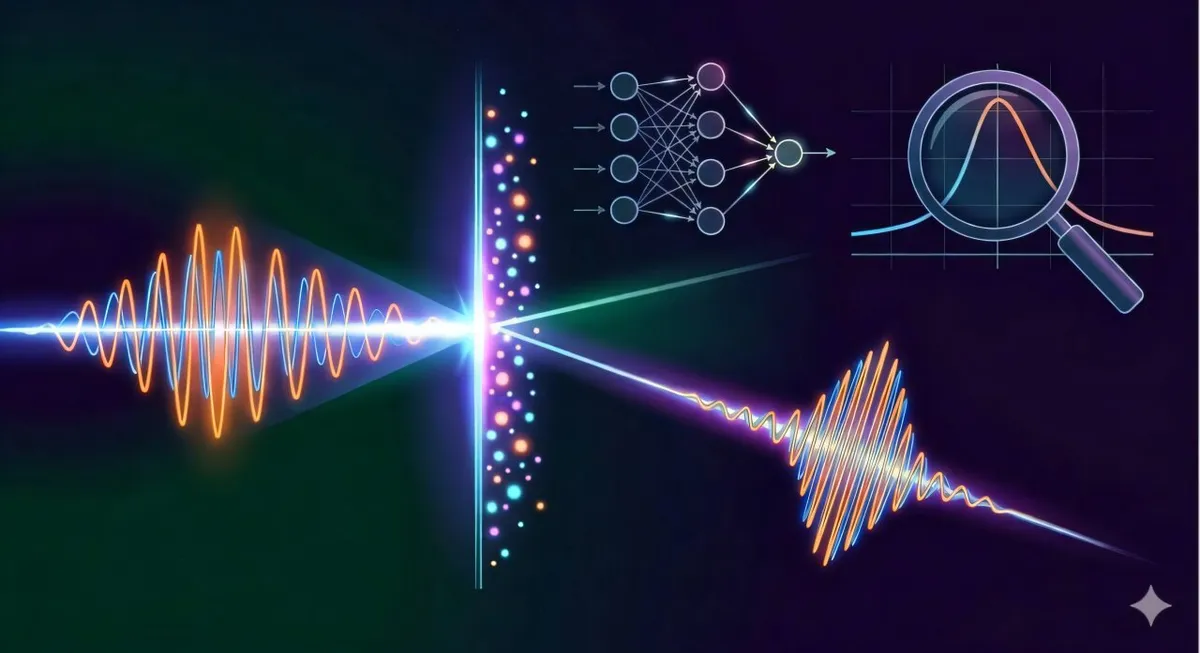
Researchers at Skoltech and the Shanghai Institute of Optics and Fine Mechanics have introduced a neural network-based method to optimize laser-plasma sources of attosecond pulses. These ultrashort light flashes power key ics experiments, and the new approach cuts down on lengthy computations by quickly pinpointing optimal settings for lab equipment.
Applications in Cutting-Edge ics
Attosecond pulse sources enable ultrafast spectroscopy, analysis of magnetic materials, chiral molecules, and electron dynamics in matter. Tuning these sources to deliver precise properties demands intensive modeling, as plasma-mirror responses hinge on laser characteristics and target details. Traditional particle-in-cell (PIC) simulations consume significant computing power.
Integrating Machine Learning with Simulations
The team merges ical modeling and machine learning. They train a neural network using one-dimensional PIC simulation data to predict the ellipticity of reflected attosecond pulses—a critical polarization metric—based on input conditions. This multilayer perceptron employs Fourier encoding for inputs.
Once trained, the network evaluates configurations rapidly within optimization loops, limiting full simulations to select validations. This outperforms brute-force sweeps, efficiently identifying high-ellipticity regimes across diverse laser and target parameters.
Performance and Scalability
The method consistently achieves superior ellipticity and scales to complex parameter spaces. “The primary hurdle in these scenarios is the expense of direct simulations, given the vast parameter landscape and resource demands per run,” states Sergey Rykovanov, head of the AI and Supercomputing Laboratory at Skoltech’s AI Center. “Our neural-network surrogate, paired with precise PIC checks, accelerates regime discovery while preserving ical accuracy.”
Broader Impact
This technique streamlines the design of customizable attosecond sources at reduced computational cost. It holds promise for other fields relying on costly simulations accelerated by neural models.