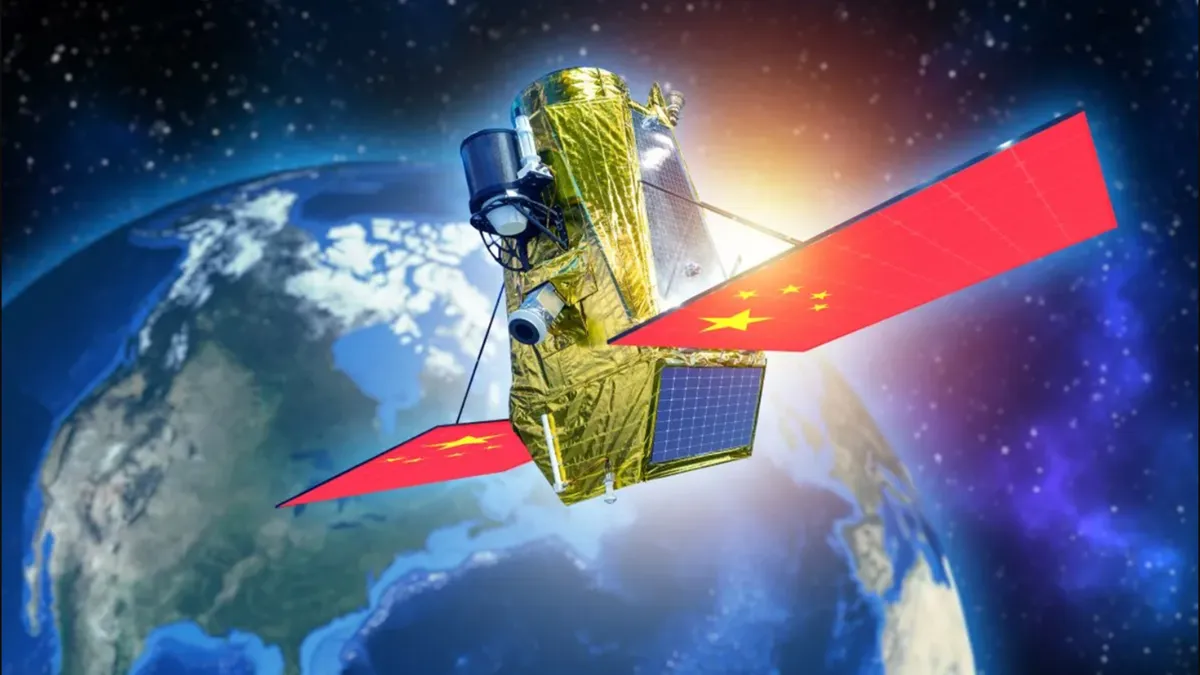
China has unveiled radar images demonstrating a geosynchronous orbit satellite successfully tracking a moving maritime target for the first time. The satellite locked onto the Towa Maru, a 340-meter Japanese tanker navigating rough seas near the Spratly Islands, from an altitude of 35,800 kilometers above Earth. This advancement enables persistent surveillance that overcomes cloud cover, darkness, and ocean interference.
Achieving Global Coverage with Three Satellites
Unlike low-Earth orbit satellites, which offer only brief passes over targets, geosynchronous radar platforms provide continuous monitoring. Lead researcher Hu Yuxin states that the new processing architecture isolates weak ship echoes from intense sea clutter at distances once deemed physically impossible.
Strategic placement of just three such satellites could deliver round-the-clock, all-weather reconnaissance of high-value naval assets worldwide, including U.S. carrier strike groups. Conventional low-orbit systems would require hundreds or thousands of satellites to match this capability.
Implications for Naval Operations
This development allows earlier detection and tracking of U.S. carrier strike groups approaching Taiwan or the South China Sea. By reducing reliance on vulnerable low-orbit constellations, China’s maritime reconnaissance network becomes more resilient in conflict scenarios.
For U.S. military planners, the breakthrough signals a shift in naval strategy. Traditional concealment tactics—relying on weather, distance, and satellite gaps—may prove ineffective. Integration with over-the-horizon radars, underwater sensors, drones, and long-range anti-ship missiles could drastically shorten warning times for commanders in the Indo-Pacific.
The focus of U.S.-China strategic competition increasingly centers on orbital infrastructure, determining which side achieves first visibility over sea lanes.
Limitations and Future Outlook
While impressive, a single demonstration tracking a commercial tanker does not guarantee reliable performance against evasive military vessels. Geosynchronous radar faces challenges from vast signal travel distances, space weather, and electronic countermeasures. China has yet to deploy a full three-satellite constellation, and operational timelines remain uncertain.